Cold traffic is the visitor who clicked your ad without knowing you exist. They did not search for your product. Your hook stopped their scroll, and the product page then asks for their card. Most DTC pages are built for the opposite visitor, the one who already wants to buy. That mismatch is why a campaign can show a healthy CTR and still lose money on the first order.
What cold traffic is
Cold traffic is anyone who has had no contact with your brand: no visit, no email sign-up, no purchase. A glossary from Hawky uses the same definition, and it describes warm traffic as people who engaged but have not bought yet, such as site visitors, video viewers and list members.
Pagedeck, a landing page vendor, says a cold visitor clicked out of curiosity, does not know the brand, has not felt the problem sharply and has no reason yet to trust a product page.
Cold, warm and hot at a glance
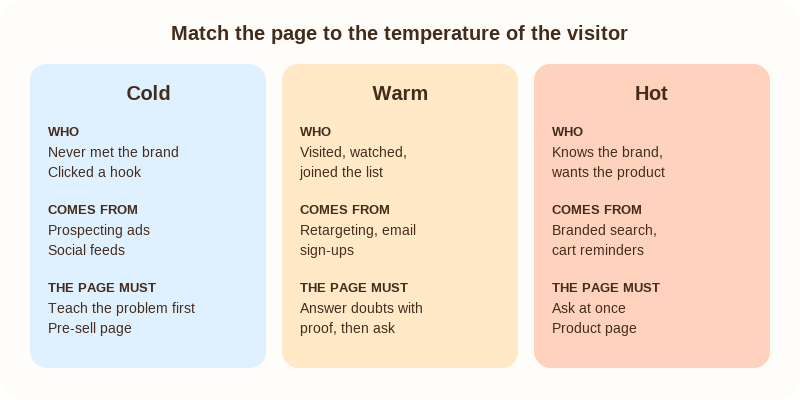
| Cold | Warm | Hot | |
|---|---|---|---|
| Who | Never met the brand | Visited, watched or subscribed | Knows the brand, wants the product |
| Typical source | Prospecting ads on Meta and TikTok | Retargeting, email sign-ups | Branded search, cart reminders |
| First question | "Do I even have this problem?" | "Can I trust this?" | "What does it cost?" |
| Best landing page | A page that teaches first | Proof beside each doubt | The product page |
The same Meta account can send cold traffic from a prospecting campaign and warm traffic from a retargeting one. Check which campaign sends the click before you judge the page.
How cold traffic converts
Three sources give a range, and none of them is a clean benchmark.
- Eightx puts Meta paid social at about 1.1% and email at about 4.2%.
- ClickMinded lists paid social cold traffic at 0.5 to 1.5% and prospecting at 0.3 to 0.8%.
- Quikly gives Meta a range of 0.7 to 1.2%.
None of these traces to one dataset, and the Eightx and Quikly figures are compilations that do not show their own sources. Read them as "roughly 1%, give or take", not as a target. Our conversion rate by traffic source post shows the spread and why it exists.
What the one hard data point says
Public cold traffic data from a real account is rare. Jon Loomer published his own for January 2022. On his site, new visitors converted at 2.60% and returning visitors at 5.24%, about double.
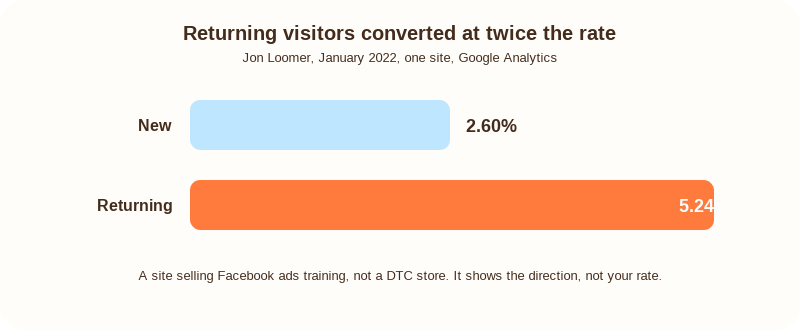
His cold Facebook campaigns did worse. They produced a 98.21% bounce rate and no conversions in Google Analytics, out of about 4,200 users for the month.
Loomer sells Facebook advertising training, not a physical product. It is one site and one month. He also notes that Ads Manager counts view-through conversions, which inflates warm results. It shows a direction, not your rate.
Why a product page loses them
A product page opens with the ask: product, price, add to cart. That is efficient for someone who already wants it. Pagedeck calls it a wall for everyone else, because it asks for the decision before the visitor has a reason to care.
The cost shows up in your CPA, because CPA equals CPC divided by CVR. At a $1.25 CPC, a 1.1% CVR gives a CPA of about $114. Doubling CVR to 2.2% gives about $57, with no change to the ad or the budget.
What a cold visitor needs
Four things, in this order.
Recognition. The first lines echo the pain or goal in the visitor's own words, so they feel they landed in the right place. This is message match.
Understanding. Explain why the problem happens and what the usual fixes miss, in plain words with no category jargon.
A reason to believe. Show how the product works, then put proof next to the doubt it answers, not in a block at the bottom.
A small next step. Hand off to the product page when the visitor is ready. Do not ask for the sale while they are still learning.
This is the job of a pre-sell page: a short editorial page between the ad and the product page. Vendors such as Pagedeck report that pre-sell pages convert cold traffic 2 to 3 times better than product pages and credit SplitBase. We could not find the underlying data, so treat it as a claim worth testing, not a promise.
Which page for which traffic
- Cold, from prospecting ads: a page that teaches first. In Brewwwup that is the Story, written as an advertorial, or the Guide, a list that teaches the problem before it names the product.
- Warm, from retargeting: a page that answers doubts with proof, or the product page if the visitor has seen it before. A Comparison helps when they are weighing options.
- Hot, from branded search: the product page, with the ask above the fold.
See the Story format live for Suntribe, or the Guide for Grüns. If you want to decide between the two ends, read advertorial or product page.
How to tell which traffic you have
Split by campaign type. Prospecting is cold. Retargeting and email are warm. Never average them in one report.
Read the new visitor rate. Compare new and returning visitor CVR in your analytics, as Loomer did, on your own store.
Check break-even. Divide CPC by profit per order. If cold traffic cannot reach that number on a product page, the page is the lever.
Test one cold audience. Send half to the product page and half to a teaching page. Judge on CVR, AOV and CPA, not on CTR.
Where Brewwwup fits
When you brew a page in Brewwwup, you can describe your ideal customer and tell Brew whether they sit at the top, middle or bottom of the funnel. A cold reader gets a page that teaches before it sells. A reader close to buying gets a short, checkable case. Try it at app.brewwwup.com, or see real examples.
FAQ
What is the difference between cold and warm traffic?
Cold traffic has had no contact with your brand. Warm traffic has engaged, by visiting, watching, subscribing or following, but has not bought.
Why does cold traffic have such a low conversion rate?
It is early in the decision. The benchmarks we found put cold paid social around 1%, and the vendors explain the gap with awareness: the visitor does not know the brand or feel the problem sharply yet. That reasoning is the sources' own, not a controlled test.
Should all cold traffic go to a pre-sell page?
Not always. Cheap, impulse products and visitors already warmed by the ad can do fine on a product page. Split test one audience and let CVR, AOV and CPA decide.