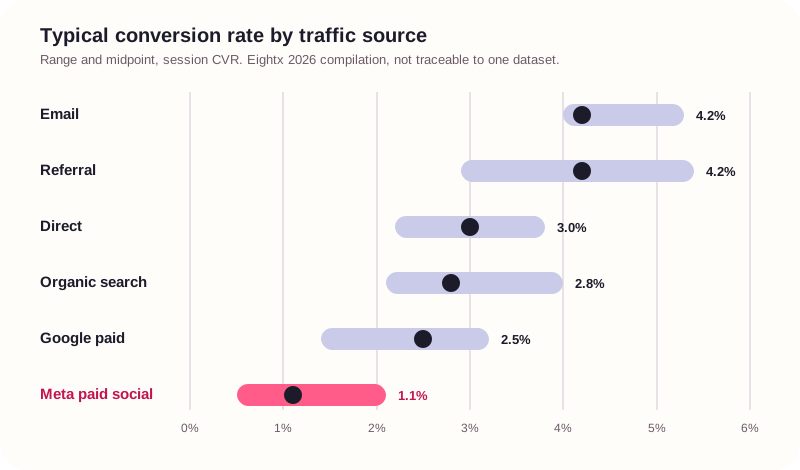
Conversion rate by traffic source is the first number a DTC team checks and the last one worth trusting blindly. The 2026 compilation from Eightx puts email at about 4.2%, Google paid search at 2.5% and Meta paid social at 1.1%. That 3-point spread is the story of cold traffic, and it explains why a campaign that looks healthy on CTR can lose money on the first order.
This post gives you the ranges with their gaps shown, then the one calculation that matters more: the CVR your ads need to break even.
The benchmarks, with their spread
| Source | Eightx midpoint | Eightx range | Quikly range |
|---|---|---|---|
| 4.2% | 4.0 to 5.3% | 4.0 to 5.3% | |
| Referral | 4.2% | 2.9 to 5.4% | not given |
| Direct | 3.0% | 2.2 to 3.8% | not given |
| Organic search | 2.8% | 2.1 to 4.0% | 2.7 to 3.0% |
| Google paid search | 2.5% | 1.4 to 3.2% | not given |
| Meta paid social | 1.1% | 0.5 to 2.1% | 0.7 to 1.2% |
Two more reference points for cold traffic: ClickMinded lists paid social cold traffic at 0.5 to 1.5% and prospecting at 0.3 to 0.8%. Eightx puts the Shopify-wide blended rate at 1.4% (Littledata, Shopify stores only).
Why you cannot take these as a target
None of these figures traces to one dataset. Eightx says it combines several aggregators without showing which one produced each cell. Quikly gives channel ranges with no named source or date. ClickMinded's cold traffic row has no citation. Three habits keep you honest:
- Compare like with like. Session CVR and placed-order rate per send are different metrics. Eightx cites Klaviyo at 3 to 5% for welcome flows and 0.05% for campaign blasts, and neither is a session rate.
- Mind the device. Quikly, citing Convertibles, reports mobile at 1.8 to 2.5% and desktop at 3.5 to 4.0% on Shopify (no year given), with mobile at 65 to 75% of traffic. A blended rate therefore leans toward the lower mobile figure.
- Treat the midpoint as a place to start. Your category, price and creative move you well off it. Eightx quotes Meta anywhere from 0.37% (hardware and automotive) to 14.29% (fitness) by vertical, from a single aggregator.
The number that matters: break-even CVR
A benchmark says what others get. Break-even says what you need. It takes two inputs you already know.
Break-even CVR = CPC ÷ profit per order, where profit per order is what an order earns before ad spend (price minus product, shipping and fulfilment costs).
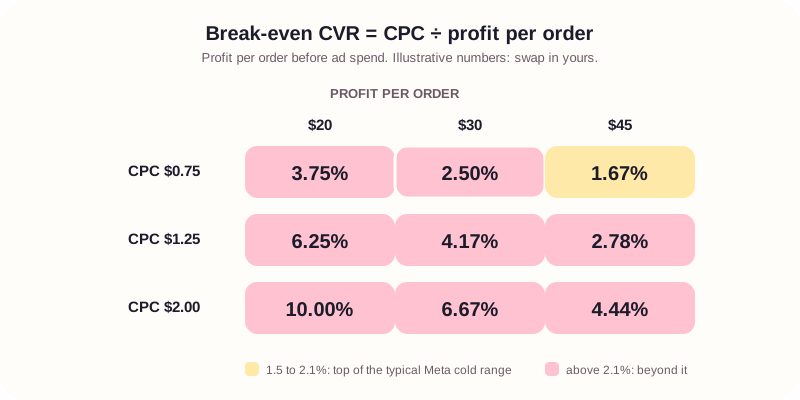
Read the grid against the ranges above. At a $1.25 CPC and $30 profit per order, you need a 4.17% CVR on the first order. Cold Meta typically converts between 0.5 and 2.1%. Eight of the nine combinations sit above that range. The ninth, 1.67%, sits inside it near the top.
That is not a verdict on Meta. It is the reason cold prospecting needs one of four things: more profit per order (bundles, a higher AOV), a lower CPC (a creative that earns cheaper clicks), a higher CVR (the offer and the page), or a plan that counts repeat orders on purpose.
What a better CVR does to your CPA
CPA = CPC ÷ CVR. Hold CPC at $1.25 and move only the conversion rate.
| CVR | CPA |
|---|---|
| 1.1% | about $114 |
| 1.6% | about $78 |
| 2.2% | about $57 |
Doubling CVR halves CPA, with no change to the ad or the budget. That is why the page is the cheapest lever in the funnel once the creative earns its clicks.
Use it this week
Pull your own CVR by source. Use sessions and orders from your store analytics, split cold prospecting from retargeting and email.
Compute break-even CVR. CPC ÷ profit per order, per product. Not revenue per order: profit.
Measure the gap. Your CVR against break-even, and against the range above. The size of the gap picks the lever.
Pick the lever. Low CTR is the creative. Weak CVR is the offer or the page. A low profit per order is the offer and the AOV.
Re-run it monthly. CPC and CVR drift with seasons and audiences. A stale break-even is a wrong one.
Where Brewwwup fits
If the gap is CVR, the page is the lever. Vendors report awareness-first pages lift cold conversion by up to 2 to 3 times (Swipe Pages, Pagedeck), a direction worth testing against your own break-even. Brewwwup writes that pre-sell page from a product URL. See real examples or try it.
FAQ
What is a good ecommerce conversion rate by traffic source?
Roughly 4% for email, 2.5 to 3% for organic and Google, and about 1% for cold Meta, per the 2026 compilations above. Use them as a range, then judge your own number against break-even CVR.
Why is paid social conversion so low?
The visitor was scrolling a feed, not searching. Eightx describes paid social as interruption traffic and attributes the lower rate to that. It is the source's reasoning, not a measured cohort comparison.
How do I calculate break-even conversion rate?
Divide your cost per click by your profit per order before ad spend. If that number is above the CVR you actually get, the first order loses money, and you need repeat orders, a higher AOV, a cheaper click or a better page.