
TL;DR
- A pre-sell page is the step between your ad and your PDP. It handles the awareness work your product page was never built for.
- Cold paid-social traffic converts at about 1 to 1.5%. Vendors report up to 2 to 3 times that when awareness is built first.
- Build one with message match to the ad, one CTA placed late, and an A/B test against your PDP on CVR and revenue per session.
A pre-sell page is a short editorial page that sits between a paid ad and a product page. It does not sell. It moves a cold visitor from "I did not know I had this problem" to "this product fits", so the PDP only has to close. Vendors report that awareness-first pages can lift conversion by up to 2 to 3 times over sending cold traffic straight to a product page.
If your ads earn clicks and your PDP earns bounces, the issue is rarely the offer. It is usually a mismatch between where the visitor is and where the page assumes they are. This post covers why, and how to fix it.
What is a pre-sell page?
A pre-sell page prepares a visitor to buy before they reach the product page. It reads like an article: a story (advertorial), a buying guide (listicle), or a comparison. It carries a single CTA, and that CTA comes late, after the page has done its job.
It is not a PDP with a new headline. It does not list every feature, stack badges, or push a discount. It frames the problem, explains how to judge a good solution, and hands the visitor to the PDP warm. You will also see it called an advertorial or a bridge page. The names vary, the role in the funnel is the same.
Why cold traffic does not convert on a PDP
Cold traffic is people with no prior contact with your brand. They saw your ad in a feed and clicked on the hook. Cold paid-social traffic converts at about 1 to 1.5% according to Eightx and Quikly.
A PDP is built for bottom-of-funnel intent. It leads with product name, price, reviews, and an add-to-cart button. A cold visitor is still asking a smaller question: "Do I even need this?" You answer a question they have not asked yet, and they bounce. That is not a design problem. It is an awareness problem, and no amount of CRO on the PDP closes a gap that sits upstream of it.
The five stages of customer awareness
Eugene Schwartz laid this out in Breakthrough Advertising (1966). Every prospect sits at one of five stages:
- Unaware. No idea there is a problem.
- Problem aware. Feels the pain, does not know a fix exists.
- Solution aware. Knows fixes exist, not yours.
- Product aware. Knows your product, has objections.
- Most aware. Knows it, wants it, needs a reason to act now.
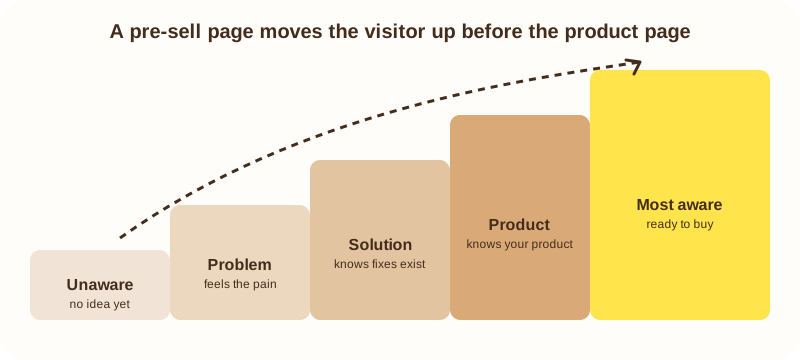
A cold creative tends to reach people at stages one to three. A PDP is usually written for stage five. The visitor lands two or three steps below where the page expects them, and your CVR shows it.
How a pre-sell page moves people up the funnel
The pre-sell page carries the visitor through the three middle steps, so the PDP only has to close.
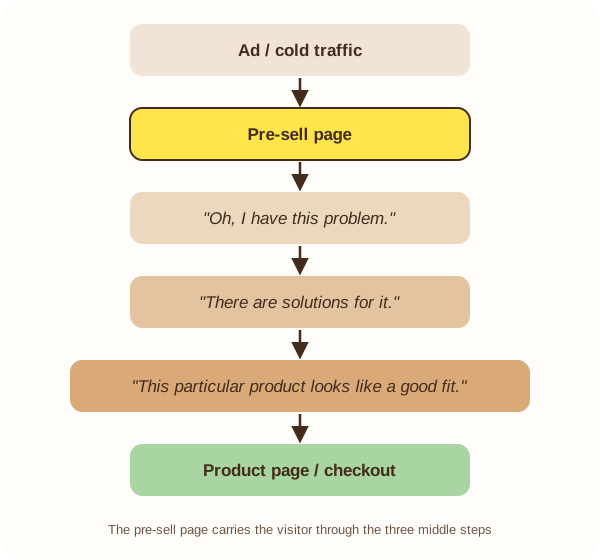
Unaware to problem aware: "Oh, I have this problem." The title and the first paragraph use the visitor's own words and echo the ad's hook. That is message match, and it keeps the bounce rate down. Then the page describes the situation they already live: the 3 a.m. wake-up, the sunscreen that leaves a white cast, the 4 p.m. crash.
Problem aware to solution aware: "There are solutions for it." The page maps the options. A guide lists what to check before buying. A comparison weighs one product type against another. The visitor learns the criteria for a good answer.
Solution aware to product aware: "This particular product looks like a good fit." Your product enters as a consequence of the criteria you just gave, not as a headline. It earns its place by matching them.
Product aware to most aware. Objection handling: fit, care, returns, who the product is not for. A reader who reaches the CTA has already said yes in their head.
Then comes the one CTA. The click-through lands on a PDP where the visitor already knows the problem, the options, and why this one fits.
What the numbers say
The figures people quote, and how far to trust them:
- Cold paid-social traffic converts at about 1 to 1.5% (Eightx, Quikly).
- Vendors report that awareness-first pages lift that by up to 2 to 3 times (Swipe Pages, Pagedeck).
- One brand saw +14% CR in a split test of an advertorial against a product page (Vasta).
Read these as directional. Most come from vendors that sell into this space, and the one split test covers a single brand over a short window. Your result depends on your AOV, price point, creative angle, and traffic source. The only number that counts is the one you get on your own traffic.
How to build a pre-sell page
- Start from the creative. Write down the angle of the ad driving the traffic: problem, feeling, or product detail. The page continues that angle. Break the message match and you lose the visitor in the first scroll.
- Pick the format. Use a Story when the ad leads with a problem or a feeling. Use a Guide when the visitor has to choose. Use a Comparison when they are weighing options.
- Spend the first third on the visitor. Their situation, their words, short paragraphs. The product arrives later.
- Only claim what you can source. Use facts from your own PDP. No invented reviews, stats, or tests.
- One CTA, placed late. Send the click to the PDP. Do not scatter CTAs through the copy.
- A/B test it. Split cold traffic between the pre-sell page and the PDP. Judge on CVR, revenue per session, and CPA, not on CTR. Run it long enough to reach significance before you call it.
Brewwwup writes the first draft for you. Paste a product URL, confirm the facts it found, and it writes the pre-sell page from only those facts. Try it at app.brewwwup.com.
FAQ
What is the difference between a pre-sell page and a landing page?
A landing page asks for the order. A pre-sell page warms the visitor first, then passes them to the landing page or PDP that asks.
Does a pre-sell page work for every product?
It helps most when the visitor has to learn something before buying: a new category, a higher AOV, a considered purchase. For a product everyone already knows, a direct PDP may be enough. Test it.
How long should a pre-sell page be?
Long enough to cover the objections and no longer. The formats Brewwwup writes run from about 350 to 1,000 words. Scannable structure matters more than length.