
TL;DR
- On advertorial vs product page, cold traffic and considered purchases favor the advertorial. Warm traffic and cheap impulse buys favor the product page.
- The only public split test we found shows a 14.2% CR lift for the advertorial, but it is a vendor case study with no sample size.
- Do not pick by opinion. Run a 50/50 test and judge on CVR, AOV, revenue per visitor and CPA.
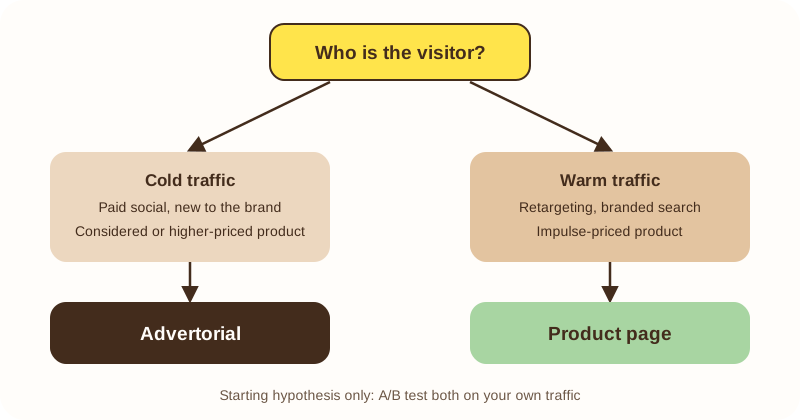
Advertorial vs product page is really a question about the visitor. A product page opens with the ask: product, price, add to cart. An advertorial opens with a problem and earns the ask later. Cold paid-social traffic is not ready for the ask, so an advertorial usually fits it better. Warm traffic already knows you, so the product page usually wins there.
If you read our post on what a pre-sell page is, an advertorial is the most common version of it. This post is for the next decision: where to send which traffic.
The short answer
Send cold traffic on a considered purchase to an advertorial. Send retargeting, branded search and impulse-priced products to the product page.
Pagedeck, a landing page vendor, draws the line the same way. It lists supplements, skincare with a named active, durable goods and higher-priced items as advertorial fits. It lists warm traffic, retargeting, branded search and products under about $25 as product page fits. Treat that as a starting hypothesis, not a law.
What each page does
A product page (PDP) is built for bottom-of-funnel intent. It shows the product, the price, reviews and an add-to-cart button above the fold. It works when the visitor already knows they want something like this.
An advertorial is an editorial page that continues the ad. Pagedeck describes six blocks: a hook, a problem frame, the mechanism (why the product works), proof placed next to the objection it answers, a handoff, and then the buy box. It moves a cold visitor up the awareness stages before the PDP asks for money.
In Brewwwup, the Story format is the advertorial. The Guide and Comparison formats are other pre-sell pages that do the same job in a different shape.
Side by side
| Advertorial | Product page | |
|---|---|---|
| Opens with | A problem and a story | The product, price and add to cart |
| Best traffic | Cold, from paid social | Warm, retargeting, branded search |
| Best fit | Considered or higher-priced products | Impulse-priced products (under about $25, per Pagedeck) |
| Length | Longer. Pagedeck suggests 800 to 1,500 words for DTC | Short and scannable |
| CTA | Late, after the handoff | Above the fold |
| Main risk | The story builds belief, then the handoff leaks. Disclosure rules apply | The cold visitor bounces |
What the one public split test says
The best-known test is a case study from Vasta. They split traffic 50/50 between a standard product page and a story-driven advertorial for the same offer, for about two and a half weeks. The advertorial won on every metric they report:
- Conversion rate: +14.2%
- Revenue per visitor: +71.8%
- Average order value: +46.5%
- Add-to-cart rate: +8.8%
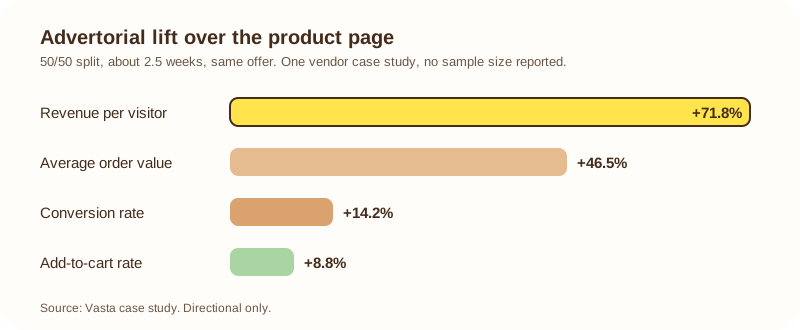
Read it with care. It is the vendor's own write-up. It does not state the sample size or whether the result was statistically significant. The offer was a free four-part training program, which is not a typical DTC product. And it is one test. It supports the direction, not a promise for your store.
You will also see "pre-sell pages convert cold traffic 2 to 3 times better". Pagedeck attributes that to SplitBase, and we could not find the underlying data. Quote it as a claim, not a benchmark.
When the product page wins
An advertorial is not free. It adds a step, and every step leaks. The product page can beat it when:
- The traffic is warm. Retargeting and branded search already know the problem. An article just slows them down.
- The price is low. For an impulse buy, the extra read can cost more than it earns. Pagedeck says so around the $25 mark.
- The product is self-explanatory. If the ad already did the explaining, a second explanation adds friction.
- The handoff is weak. A good story that ends in a weak CTA moves the drop-off one page down. Pagedeck puts the buy box after the handoff, and the handoff should read as the story's conclusion.
Label it
An advertorial is paid content, and platforms and regulators care. Pagedeck's summary of FTC native advertising guidance is that disclosure should be clear, plain ("Advertisement") and visible before the reader engages, not buried in the footer. It also notes that Meta's policies apply to the destination page, so do not imitate a news site or pass paid content off as independent journalism.
Check the FTC and Meta sources yourself before you launch. In Brewwwup, Story pages are written as brand-authored content and have an optional disclosure label you can fill in above the title.
How to test it on your own traffic
Pick one ad angle. One advertorial per angle. The page must continue the hook, or you lose message match.
Choose the metrics first. CVR, AOV, revenue per visitor and CPA. Not CTR. Write them down before the test starts.
Split 50/50. Same ads, same audience, same budget. Only the destination changes.
Run to significance. Vasta ran about two and a half weeks. Your volume decides yours. Do not call it after two days of good ROAS.
Read it by segment. A win on cold traffic says nothing about retargeting. Keep warm audiences on the PDP unless a test says otherwise.
Brewwwup writes the first draft of the advertorial for you. Paste a product URL, confirm the facts it found, and it writes from only those facts. Try it at app.brewwwup.com.
FAQ
Is an advertorial the same as a pre-sell page?
An advertorial is one kind of pre-sell page: the story format. Guides and comparisons are also pre-sell pages.
Can I use an advertorial for retargeting?
You can test it, but the usual guidance is to keep retargeting on the product page. Those visitors already know the problem, so the extra read may only add friction.
How long should the advertorial be?
Pagedeck suggests 800 to 1,500 words for DTC. Brewwwup's Story runs from about 600 to 1,000 words when it is written from confirmed facts only. Cut anything that does not answer a doubt.